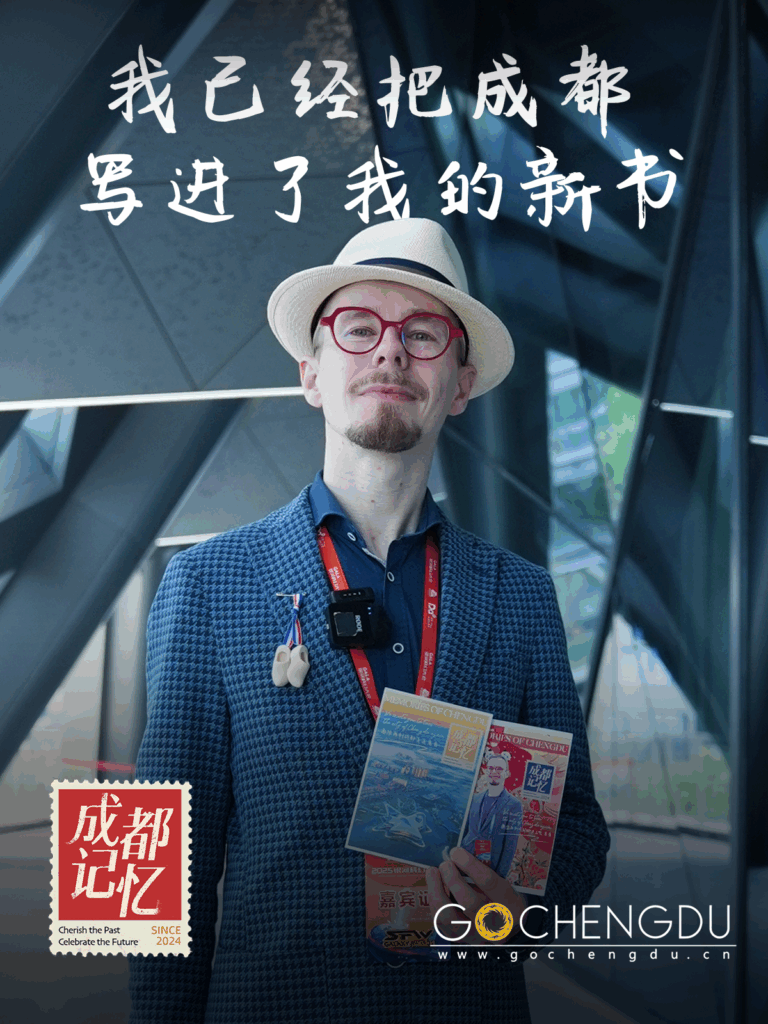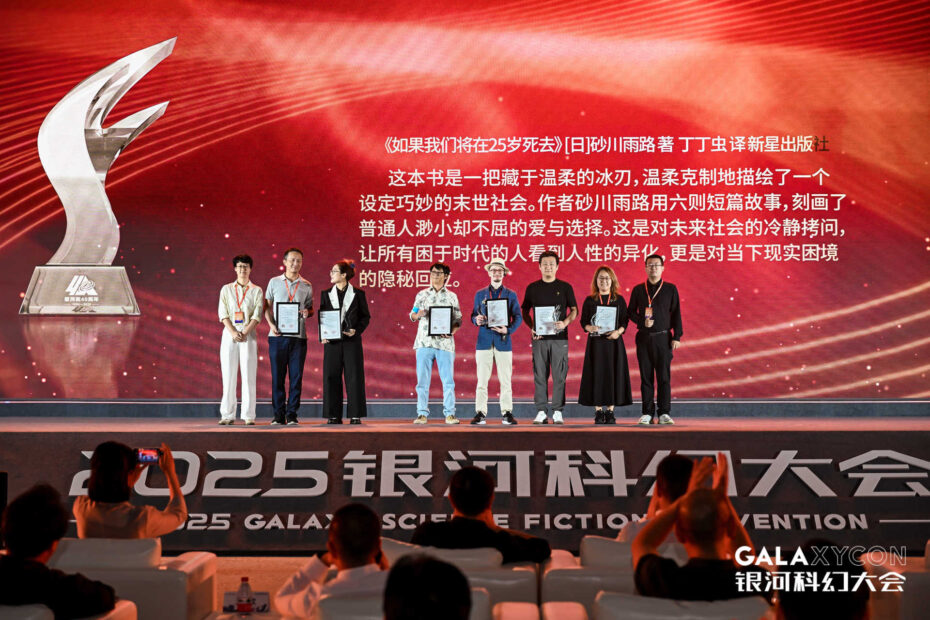
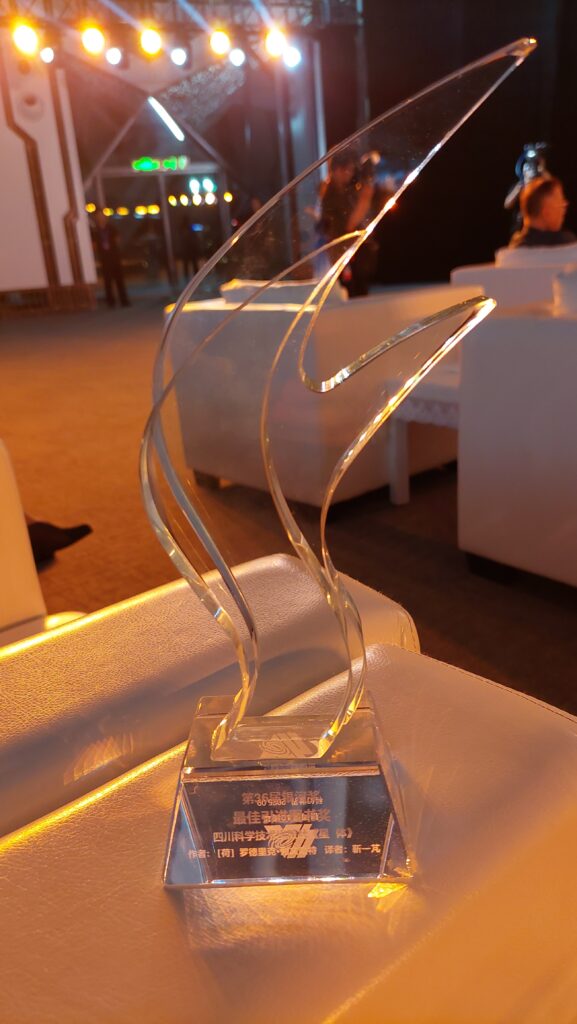
The 40th anniversary of the Galaxy Awards—given yearly by Chinese publisher Science Fiction World since 1986—did not go quiet into that balmy Chengdu night. A three-day, newly rebranded convention had been organized around it, one with special meaning to the local fandom and of VERY special importance to yours truly, as it was the moment the Chinese edition of my SF novel Star Body received the Galaxy Award for Best Introduced Book, or best foreign novel.
Winning an award
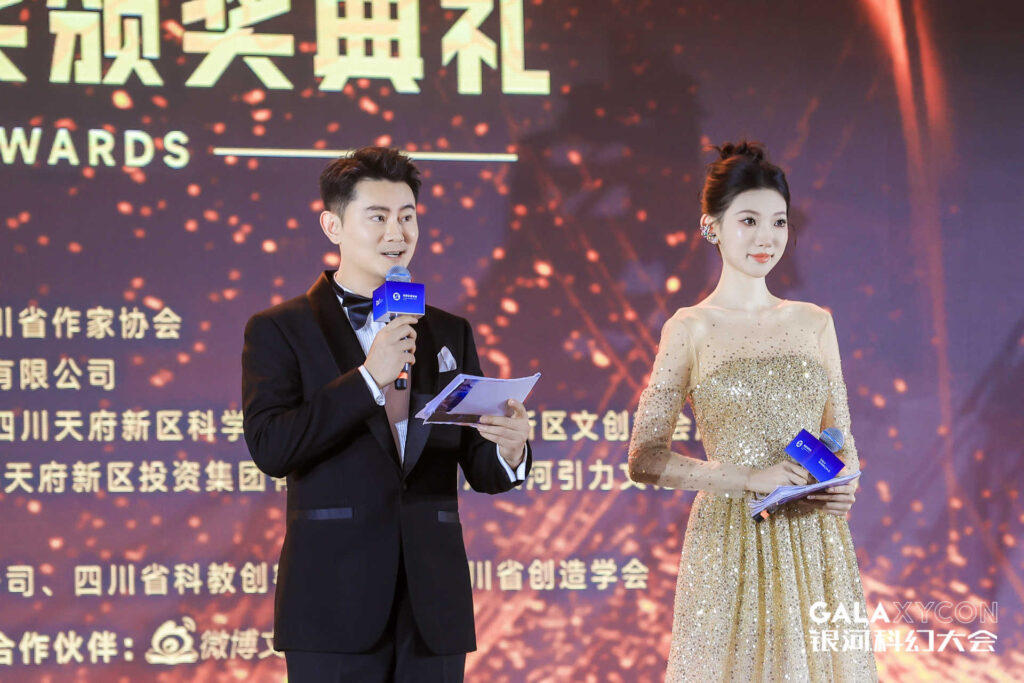
Let’s work our way back from that. I spent much of the award ceremony in something of a fugue state. It was an all-stops-pulled-out show with spectacular video walls and professional presenters in a brand new event dome, following an equally lavish opening ceremony in the morning. After noting the category coming up, hearing my name with a delay through the translation earpiece, being ushered onstage, receiving the trophy and certificate, bathing in applause, equal parts numb and exhilarated, then back to the seat, I remember spending much of the time feverishly communicating with my fiancée, friends, family and fandom back home. Photos came online almost as soon as they were snapped, so there was a constant thrill of updates coming in, more news, more joy to share.
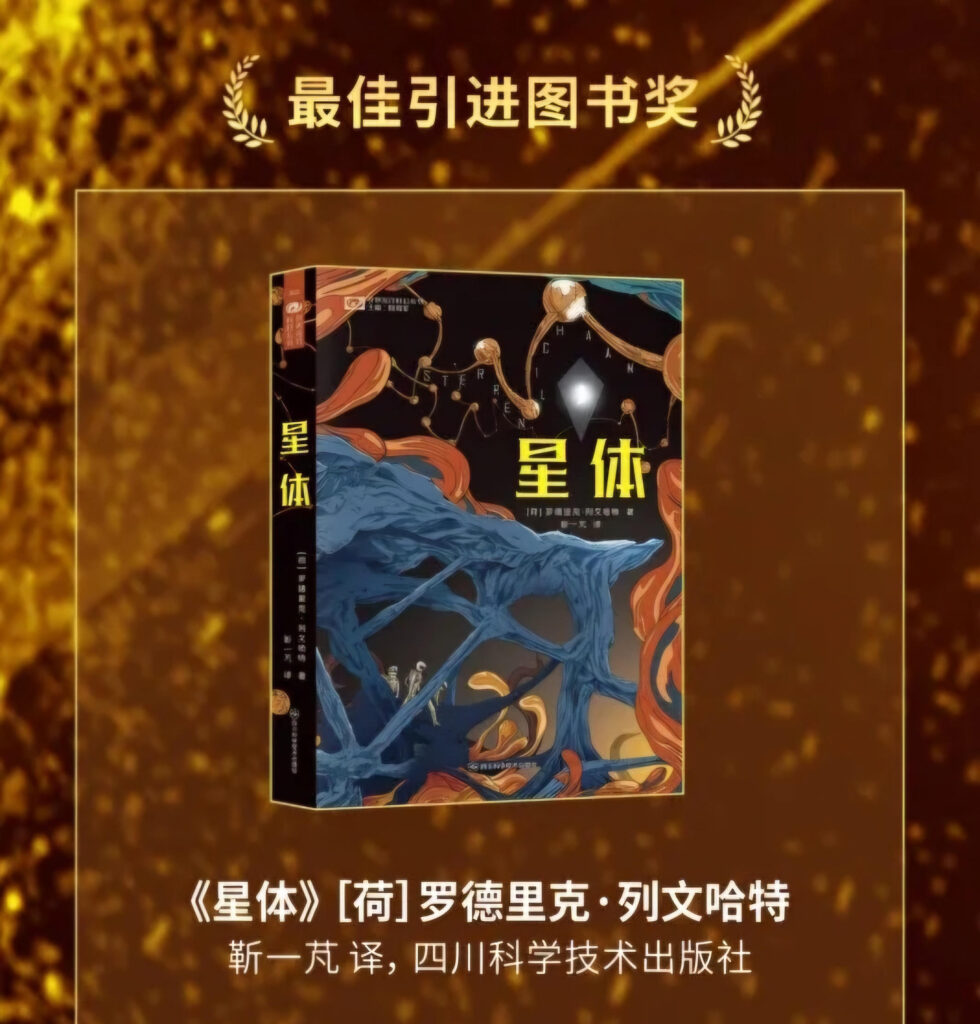
To be precise, two entries won the award in the category: my novel Star Body (or “Sterrenlichaam” in Dutch) and Sunagawa Amemichi’s Japanese anthology If We’re Going To Die At 25. This occurs when the jury gives equal amounts of points on the reader-selected ballot and there’s a straight-up tie. I truly didn’t know if I was going to win beforehand—the competition seemed fierce with some award-winning titles running alongside me—but there were favorable signs. My presence, perhaps counter-intuitively, wasn’t one of those, as I had been invited long before the voting rounds were held and the shortlist was announced. But Chinese SF critic San Feng said the novel’s star rating on book site Douban was a good indication of likely success and my editor was equally confident.
To be even more precise, I am not even the actual recipient of the award! “Best Introduced Book” is an award—technically—handed out to the publisher of the foreign novel, honoring how bringing such a publication to bear in the first place is a true team effort. It required the dedication of many people including editor Yijing Liu, translator Peggy Jin, the many people from SFW’s printing and logistics departments, the bosses for according the project, etc etc. My friends there kindly allowed me to take the award home, however, which means a lot to me.
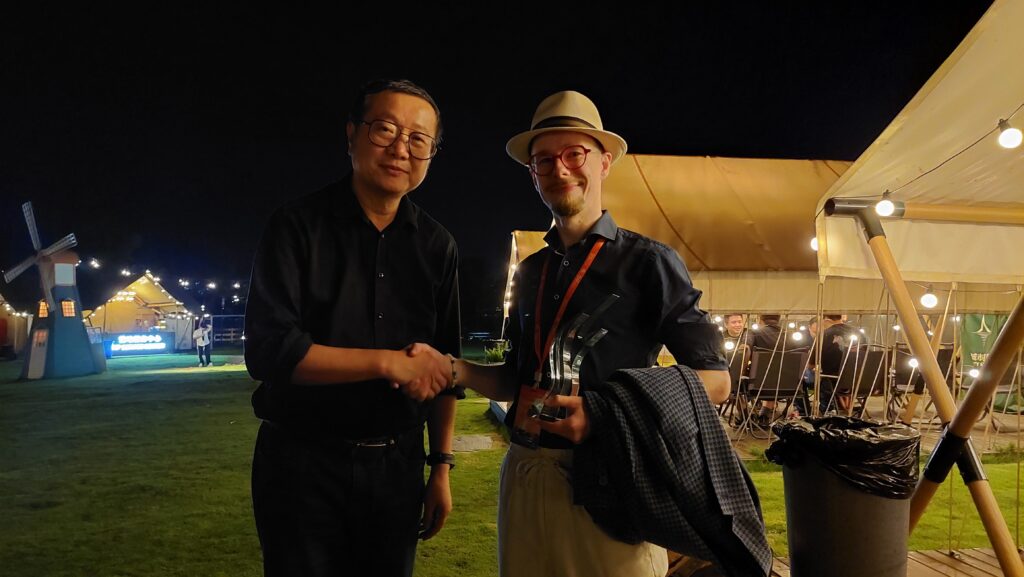
The rest of the evening went by in a rush. After the ceremony, which ended with a heartwarming montage of historical pictures from the archive of SFW, showing luminaries such as Tan Kai and now-established writers when they were young, we went to an afterparty where I talked to many people and shook hands with Cixin Liu. At midnight I wished everyone a pleasant night and returned to the hotel to fall into a ten-hour torpor, made possible by my fortunately clear schedule the morning after.
It has now been a week since the event and I am still figuring out what exactly winning the award will mean. Some additional publicity, sure: together with my agent back in the Netherlands we sent out a press release that already got picked up by several outlets and will likely invite further articles and interviews. Beyond that, I am hoping this will create momentum for additional international publications. With a Galaxy Award win, publishers might notice Star Body and be interested to know why it made such an impact in China. We’ll see what happens; all I can do is enjoy the ride and embrace whatever comes.
People mountain, people sea
With that out of the way, time for Galaxycon itself. The event was held in a newly developed piece of town, Tianfu New Area, that aims to be a hotspot for science, technology and development. A Silicon Valley for Sichuan province, if you will. Fitting surroundings for a science fiction event. Writing SF, as British author and academic Adam Robert writes in his (highly instructive) work The History of Science Fiction, is after all from certain viewpoints a mode of doing science—albeit one easily frowned upon because SF can sometimes get silly and weird and militaristic and childish and all of the above.
Any way you looked at the Galaxy Science Fiction Convention however, you could tell it was going to be a treat. The location added unique flavor: Xinglong Lake is a beautiful, if sometimes hauntingly unpopulated location because of its relative newness. You won’t find here the usual amounts of people that throng at any popular place or in the subway downtown (which I learned is rather hilariously captured in the Chinese expression “people mountain, people sea”, which tells us something about the geographical dimensions of crowds here). Galaxycon struck a nice medium between the two: pleasantly attended while still offering breathing room and privacy.
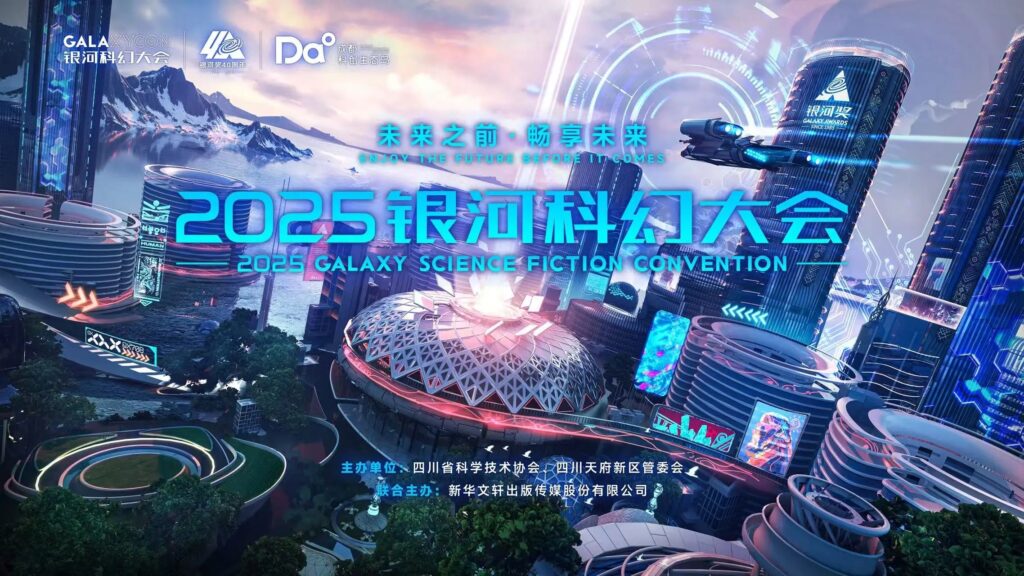
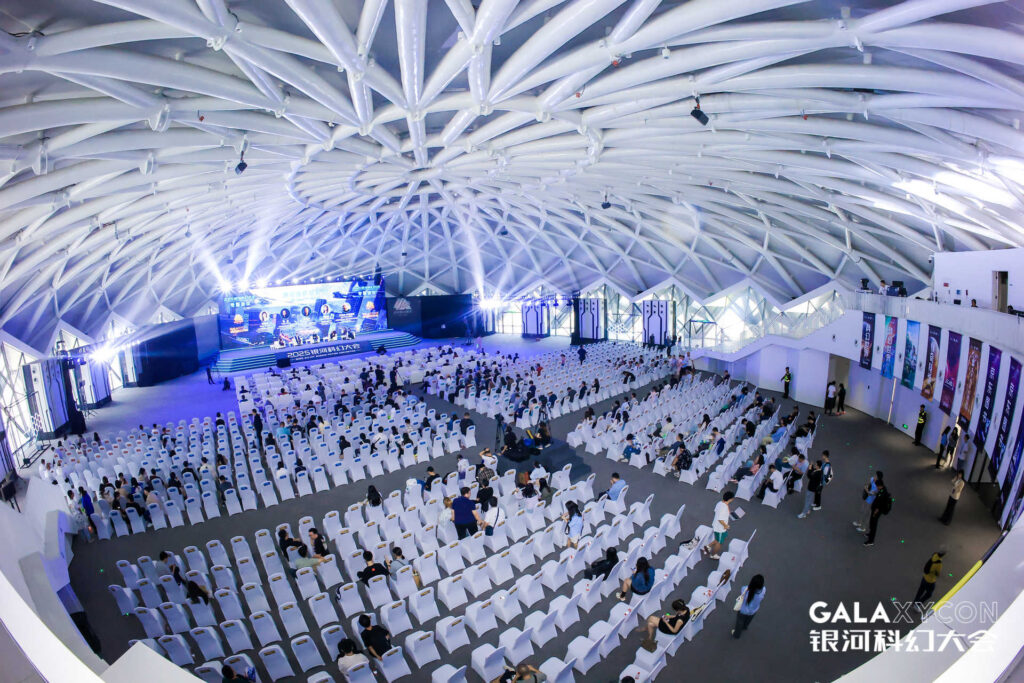
The three-day event had a lopsided structure. The core ceremonies all took place on Friday the 19th of September, Saturday the 20th was filled with panels and an “SF Only” fan convention, Sunday the 21st petered out on a few remaining lectures—but you could tell everyone was getting quite tired and glad for the reprieve. After a storm-filled midweek, the weekend had turned happily sunny, which surely was a blessing from whatever SF-loving deity above that wanted everyone to have a good time.
I can’t speak about the con experience as a regular visitor, but as a guest, everything was smoothly arranged. As always, the hotel already doubled as a convention site: at breakfast, lunch and dinner I sat and caught up with other guests such as Neil Clarke, Taiyo Fujii, Nick Wells, Esther Maccallum-Stewart, Baoshu and Nicholas Whyte, the elevators and lobby serving as meeting places too. The commute from the hotel was an easy 20 minute walk along the promenade or a short ride on the special buses for the less workout-inclined.
On Saturday I had a signing session for which my excellent current editor Fan Wang had arranged possibly the best gift I’ve ever received: two Chinese-style stone stamps with traditional scarlet ink paste, one featuring the face of a dancing lion, the other my name in ancient glyphs. Signing copies of Star Body with those two elicited frequent gasps of awe and pleasure—including from me. It looks brilliant. Later that day I discussed the state of European SF on a panel featuring such luminaries as Taiyo Fujii, Kim Boyoung, Yan Xi and Rafał Kosik.
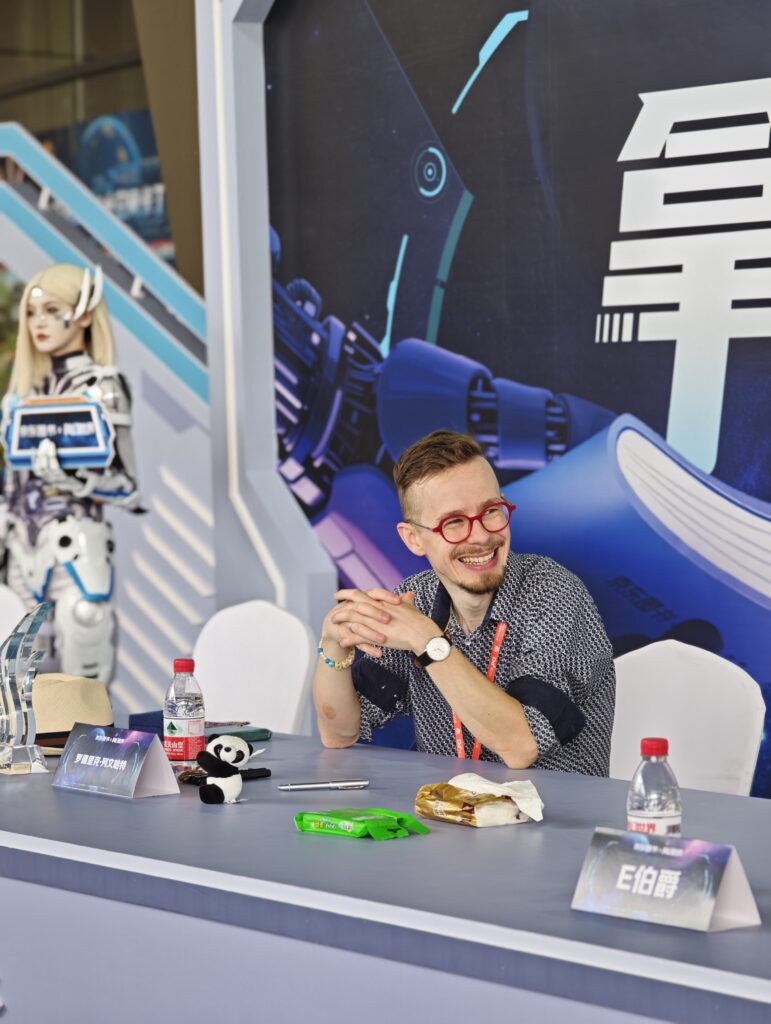
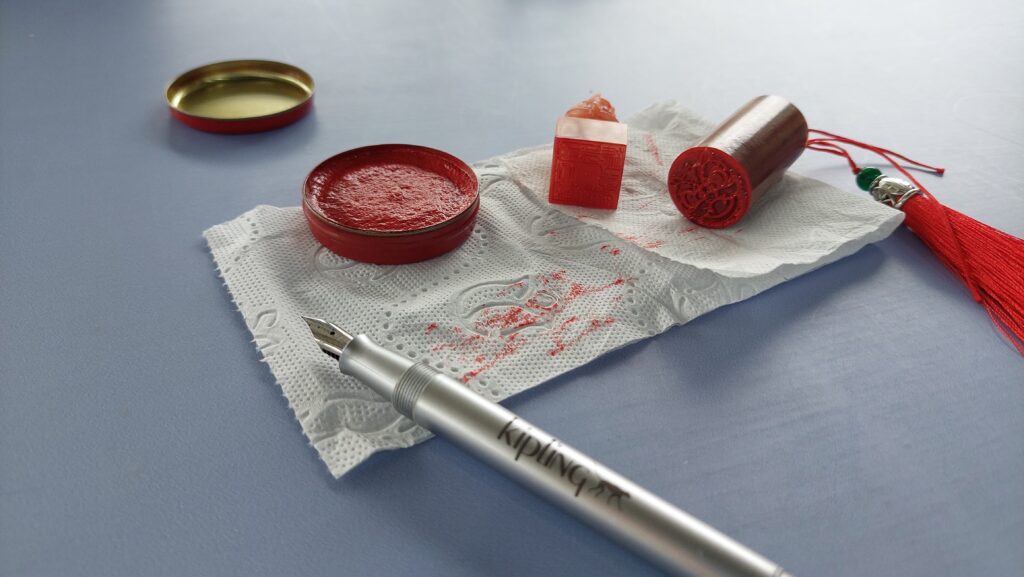


Soon, Galaxycon was already coming to a close and I had caught only a tiny fragment of it. The event was overwhelming for many reasons, all of them good, and I’m grateful and humbled that I was so warmly summoned to be part of it!
Loss of face
Let us now wind back to 2023, the year of Chengdu Worldcon at the newly constructed Science Fiction Museum. I had been one of many international guests to attend and was extremely impressed by the scale of what was being achieved. It was my first visit to China. Needless to say, I had a wonderful time and I assume so did all the foreign invitees. At the time, I thought this was surely one of the proudest moments in Chinese SF fandom—but I later learned, much to my sadness, that I was mistaken. For two reasons, Chengdu Worldcon became something that, if not a memory of embarrassment, embodied at least a deeply uncomfortable feeling.
The first reason was that organizationally, people worked so hard, far too hard, that they burned out. Perfection comes at a cost. Scale comes at a cost. Coupled with behind-the-scenes struggles, this left a bitter taste in many that helped to organize the spectacle. The second reason was the Hugo Award disaster that came shortly after. This was a publicly unfolding nightmare that left more than a few damaged. In the first stage it became apparent that the Hugo ballot had been manipulated to keep certain nominees and certain book titles low on the list, prompting some to question whether the Chinese could be trusted with such things. It soon turned out, however, that it was not the Chinese side of the Hugo committee, but the American side who had doctored the ballot. Likely with the best of intentions, certainly ill-conceived and disastrously handled. The fallout was brutal: the culprits were censured or reprimanded by the Worldcon Intellectual Property non-profit and were all but ex-communicated by the global, online community. Combined, Chinese SF fandom felt they had lost a lot of face and had put in crazy amounts of work only to get shortchanged or even cheated by events outside their control.
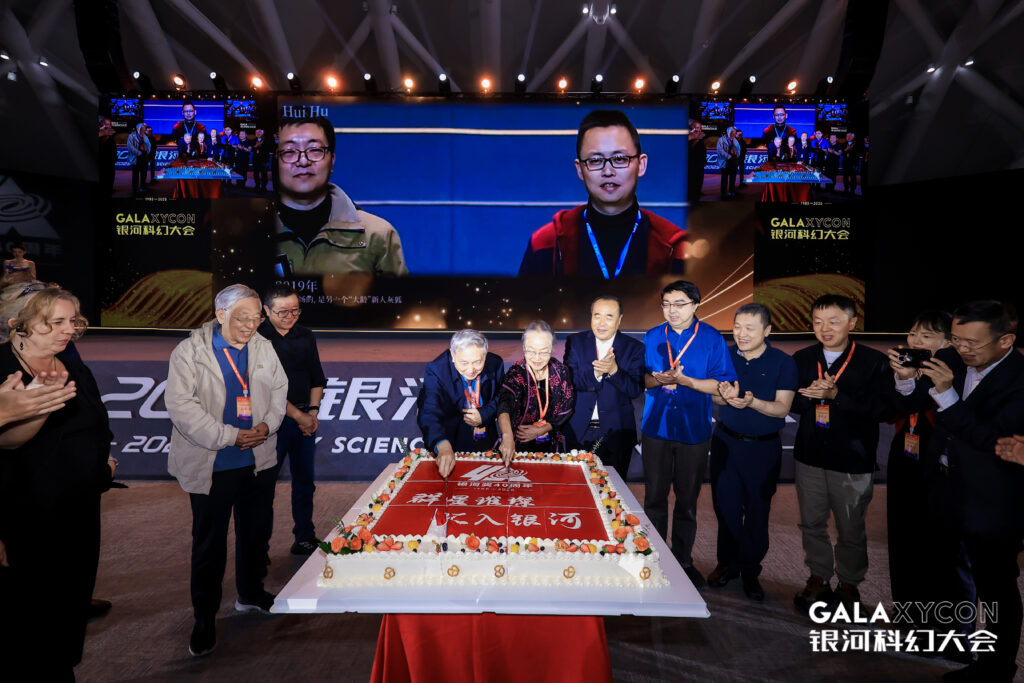
Two years later, Galaxycon would serve as a moment of catharsis. A convention that was what Chengdu Worldcon was supposed to have been: a celebration of Chinese science fiction, a place to hang out with peers, meet fans, relax and have fun, take photos with friends and people you admire, eat a giant 1m² cake in a grand nostalgic celebration of forty years of pioneering and promoting SF. I could sense the relief and happiness in my Chinese writing colleagues. If I had to put it into words, it would be: “We did it. We can finally let it go.”
Growing Galaxycon
That’s not to say organizing this wasn’t hard work. It always is. Erecting this biannual festival around the awards took countless hours of labor and started over a year beforehand. Note that I was invited to attend Galaxycon (before its rebranding, when it was still named China (Chengdu) International Science Fiction Convention) at Glasgow Worldcon in the summer of 2024. All of that effort led to the event itself. Con organizers the world over will attest to the fact that in those surrounding nights, you’ll be lucky if you get a handful of hours of solid sleep. The rest of the time is for running around, welcoming guests, putting out fires.
It was hard work indeed, and some of the editors at SFW told me they had slept “as in a coma” the day after to regain their powers. “By the time the conference ended, I was physically there but mentally exhausted,” wrote the unstoppable Sara Chen, one of the organization leads who seems to be at the center of everything. But they all said so smilingly. This had been a good experience to them, instead of a punishing one.
And the future might promise—perhaps threateningly so—even greater challenges. During the convention, there was a panel themed “how can we turn Galaxycon into Worldcon?” This seems to be a genuine desire. To transform what has historically been an award servicing and celebrating Chinese authors (with the incidental foreign publication in the mix, the word “international” wasn’t in its original title just for fun!) into a worldwide prize with all the accompanying logistic and linguistic hurdles. It makes some sense, as SFW is an outward-looking publisher with a healthy interest in what happens outside China’s borders—consider how it even has a dedicated “Translations” magazine for foreign SF stories! And there will be plenty of other big awards in the country to fill in any gaps left by this move. At the same time, it’s inevitable that some of the character and specificity of the Galaxy Awards will be left behind too. There’s always a tradeoff. I will be rooting for them no matter which way they go.
Increasing the scale to “Worldcon” size will be quite the challenge, though. Organizationally, there can be no doubt that the current teams are capable of doing it. But I kindly propose that, if this should come to pass, SFW hire several fulltime staff members to organize the convention, rather than asking the editorial teams to take on such a burden.
Chinese writing retreat
The end of the weekend meant for many a swift, sometimes nightly return flight home. I was one of the last to remain in the hotel that Sunday, because I’d be staying in China for the next five weeks. The reason is that I was also invited to serve as a mentor in the Future Creation Workshop, held by the Fishing Fortress Science Fiction Academy in Hechuan. Taking place late October, bridging the two events in China would be an excellent opportunity for me to explore both Chengdu and Chongqing, and provide a much-needed writing retreat.
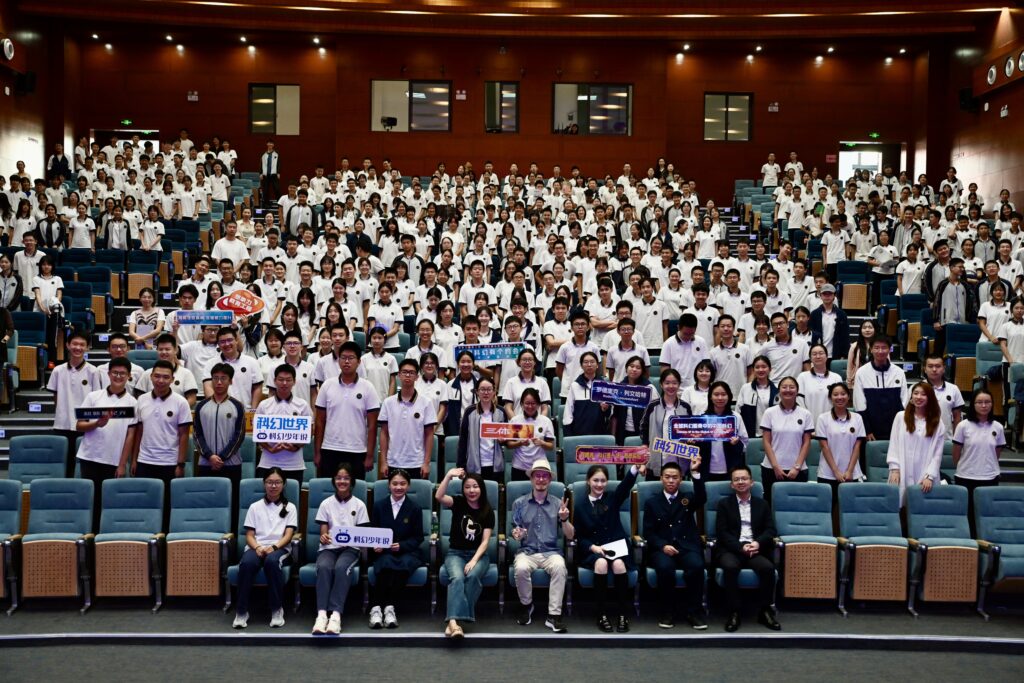
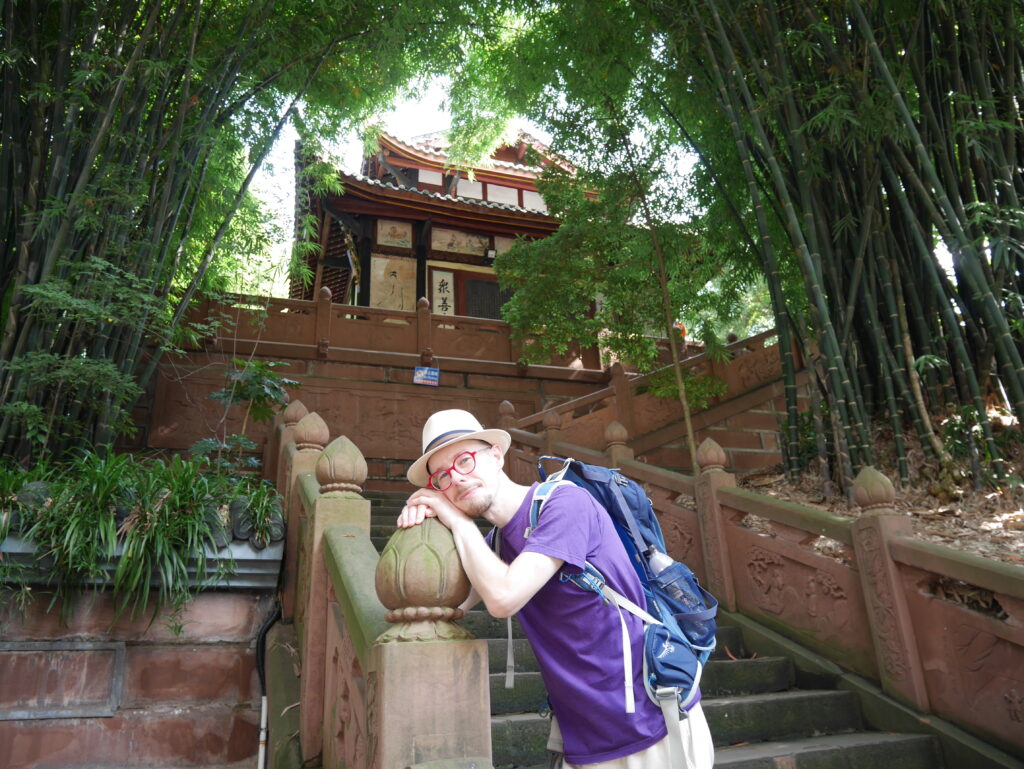
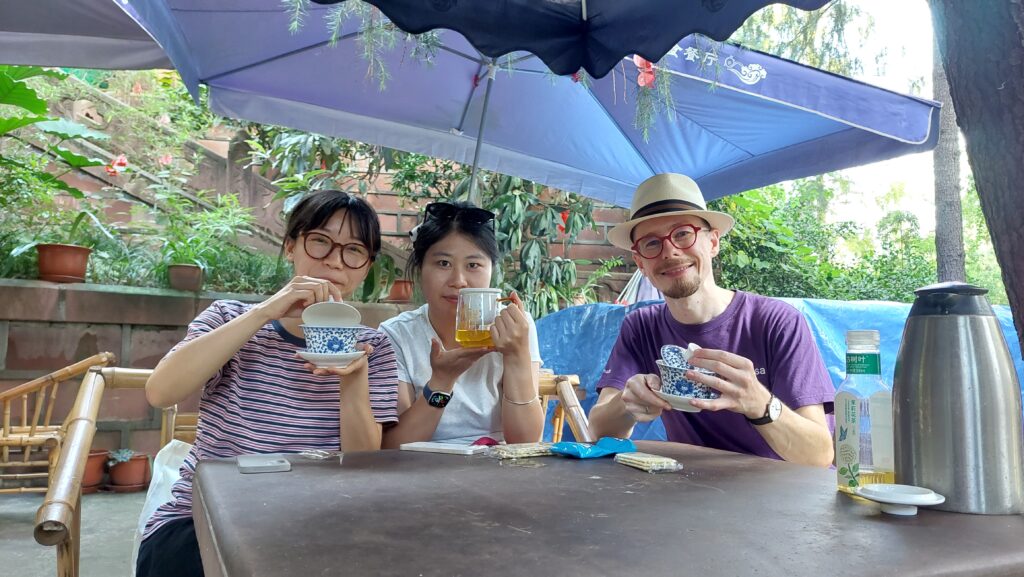
As I was staying in Chengdu anyway, SFW arranged another lecture and panel at the Chengdu Tianfu School the following week, for six hundred excited students! I visited the tiny-but-impressively stacked Ansible café, a true community space for SF enthusiasts. The next morning, editors Fan Wang and Huan Yan were happy to trade a work day at the office for the very important task of taking me to see pandas, eat vegetarian hotpot at Buddhist Wenshu Monastery and drink tea on a Daoist temple compound. To prove that this was not wasted time for any of us (bosses take note!), I bookended the trip with two serious writing sessions, producing a new short story in a single day. Rewrites and edits pending.
While I’m typing this, the trip is still ongoing. This report is, in fact, a real distraction from getting on with my new SF novel, which is the actual goal of my stay. If I don’t make headway into this project, I’ve even decided that the whole journey was for nothing. So why am I still writing this? I should stop! Stop now! You’ve said all you wanted to say about Galaxycon and your silly adventures, they got the message that it was awesome, it’s a total given you’re a stan for Chinese SF, now come on, quit it! Get those fingers off the keyboard, Leeuwenhart! RIGHT NOW!
Bonus report!! Two collaborators on Star Body write their thoughts about winning the Galaxy Award!
First up is editor Yijing Liu, who guided the Chinese edition to completion through its many years of development:
“Star Body winning the Galaxy Award for Best Introduced Book is another milestone in my career as a Sci-Fi editor. It is always exciting to receive feedback from readers, as well as recognition through awards, for every book I have the pleasure of working on.
Star Body is special in that it is rich with Dutch and East Asian influences and offers a glimpse into the science fiction landscape of a non-English speaking country. It represents voices that might otherwise go unheard in the English-dominated genre, and I’m so glad to have helped it find its readers. The award shows that we have done the right thing together. Also, I want to wish Roderick the best luck in writing more stories that will connect us across cultures.”
Secondly, translator Peggy Jin chips in about the process and what it meant to her:
“Hello everyone! I’m Peggy JIN, the Chinese translator of Star Body. From the moment I received and read through the script for trial translation (which I’ve heard was quite a competition!), I was captivated. I want to take this opportunity to extend my heartfelt thanks to the Sichuan Publishing House of Science & Technology and Mr. Roderick Leeuwenhart for entrusting me with the wonderful opportunity to translate this extraordinary book.
Star Body is a fable that transcends cultural boundaries, an adventure that delves into themes of destruction and redemption, and a narrative that masterfully weaves together the cold vastness of the universe with the delicate intricacies of humanity. It’s no surprise that it has quickly garnered a large following in China, and I hope my translation has done justice to its magnificence.
Thank you all, and I look forward to seeing you with the next book!”
My utmost thanks again to you two and the others who helped bring my novel into China—including Sara Chen and authors Xia Jia, Taiyo Fujii, Baoshu and Stanley Chen, who all supported me along the way. This is in every way your Galaxy Award as well!